
Identify the person, booking, time, or place that makes the plan fixed.

Present Continuous for Arrangements
Use the present continuous with a future time to describe an arrangement that has already been organised with another person or clear details.
Present Continuous for future arrangements
UseDescribe a future event that has already been arranged with a person, time, or place.
Core formsubject + am/is/are + verb-ing + future time
Arrangement questionam/is/are + subject + verb-ing + future time?
RememberA future time expression makes the future meaning clear: tomorrow, on Friday, at six.
ชื่อไวยากรณ์ภาษาไทย — เปิดเมื่อจำเป็น
Present Continuous ใช้กับนัดหมายอนาคตที่จัดไว้แล้ว โดยมีรายละเอียด เช่น คน เวลา หรือสถานที่ และควรมีคำบอกเวลาอนาคตให้ชัด
Your goal
By the end of this lesson, you can describe, ask about, change, and reconfirm an organised future arrangement with clear details.
คำอธิบายเป้าหมายภาษาไทย — เปิดเมื่อจำเป็น
บทนี้ฝึกพูดถึงนัดหมายที่จัดไว้แล้ว ไม่ใช่เพียงความตั้งใจ โดยต้องมีรายละเอียดที่แสดงว่านัดหมายเป็นรูปธรรม เช่น ใคร ทำอะไร วันเวลา และสถานที่
Progress focus LCFP
LC · Language Control
Control the target pattern so the intended meaning remains clear.
Control the target pattern so the intended meaning remains clear.
FP · Functional Performance
Complete the lesson’s real communication outcome without teacher-supplied sentences.
Complete the lesson’s real communication outcome without teacher-supplied sentences.
Your grammar path
Keep the present-continuous form and add a clear future marker.
Repeat the full arrangement after one detail changes.
30-minute lesson route
3 minArrangement baseline
5 minEvidence of arrangement
5 minForm and question
6 minListen and complete
7 minArrange and reconfirm
4 minFeedback and retry
Distinguish an arrangement from a general intention
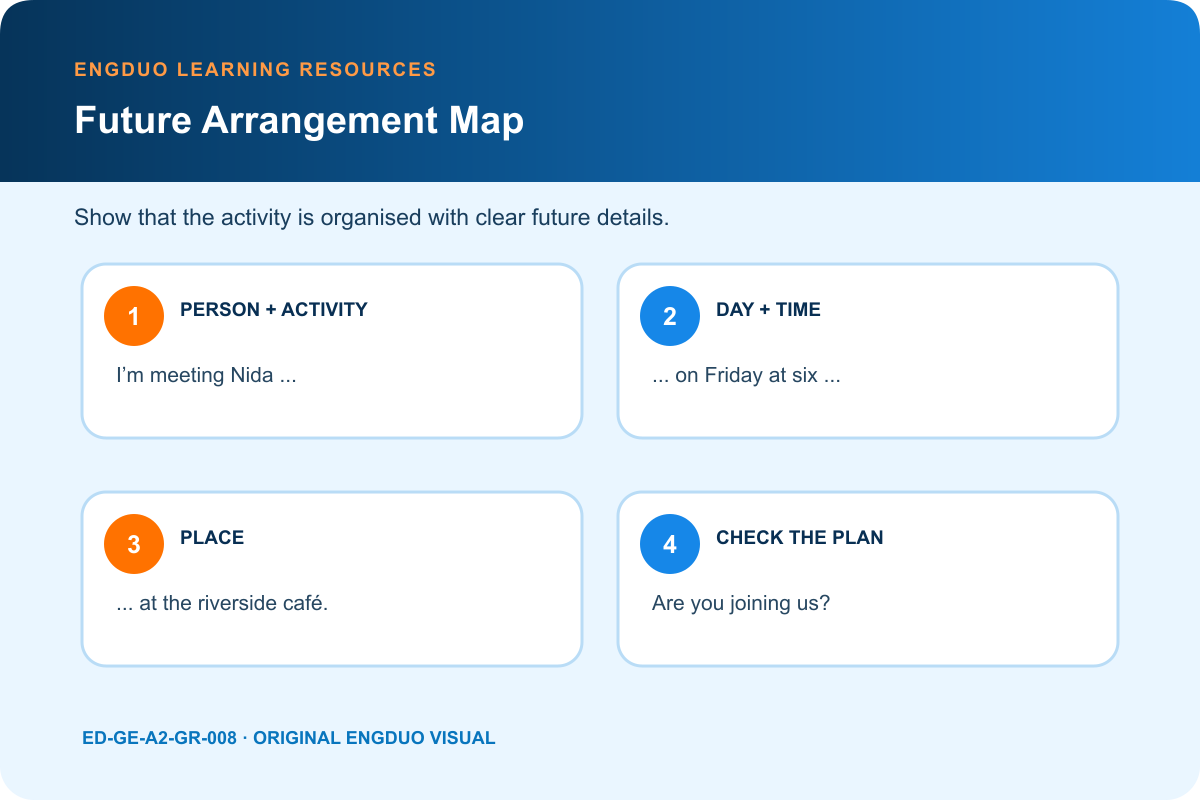
Choose future events with another person, appointment, booking, time, or place. Explain which detail shows that the event is organised.
How to run Stage 1
3 min: Compare one vague intention with one organised arrangement.
Use the present continuous with future time
Statement: I’m meeting Mali on Friday. Question: Are you meeting Mali on Friday? Negative: I’m not meeting her in the morning.
How to run Stage 2
5 min: Identify the people, time, place, or booking that fixes the event.
Add the essential details
Engduo Audio: Listen for meaning first. Audio never starts automatically.
Listen for the people, activity, day, time, place, and evidence.
Track the future question, confirmed arrangement, and later availability.
Include who, activity, day or date, time, place, and one piece of evidence such as a booking or agreement. A list of intentions is not enough.
How to run Stage 3
5 min: Build affirmative, question, and negative future-arrangement forms.
Recover the organised details
Listen to both models. Complete an arrangement card and underline the detail that shows the event is fixed.
How to run Stage 4
6 min: Play both models and complete the arrangement cards.
Arrange, change, and reconfirm
Create one two-person arrangement. Ask three detail questions, change one practical detail, and repeat the complete final arrangement so both people agree.
How to run Stage 5
7 min: Arrange, change one detail, and reconfirm the final plan.
Final practice: Confirm a real future arrangement
Task: Agree on the person, activity, day or date, time, and place. Ask three detail questions, change one detail, and reconfirm the complete arrangement.
Success: The arrangement is clearly organised, future time is explicit, and the learner handles the change and confirmation independently.
LC · Language Control
0 Frequent form problems obscure the intended meaning.
1 Meaning remains clear with some prompting or self-correction.
2 Controls am/is/are + verb-ing with future time across statements, questions, and changes.
FP · Functional Performance
0 Does not yet complete the communication outcome.
1 Completes most of the outcome with visible prompts.
2 Completes, changes, and reconfirms the full arrangement independently.
How to run Stage 6
4 min: Score LC and FP, repair one missing be or future-time clue, and retry the confirmation.
คำอธิบายภาษาไทย — เปิดเมื่อจำเป็นเท่านั้น
ใช้ Present Continuous กับอนาคตเมื่อมีนัดหมายที่จัดไว้แล้ว เช่น I’m meeting my teacher at six tomorrow. ต้องมีคำบอกเวลาอนาคตและรายละเอียดที่แสดงว่านัดนี้เป็นรูปธรรม
Continue your learning path
Teaching references
CEFR Companion Volume — used for communication outcomes and observable progress.
Content and media rights
© 2026 Engduo Thailand. This lesson and its original instructional design, text, visuals, and prepared media are for authorized Engduo use. Do not copy, download, republish, sell, scrape, or use any part in another course, website, dataset, product, or AI system without written permission, except where applicable law permits.