
Decide whether it is a prior intention, personal arrangement, fixed schedule, immediate decision, promise, offer, or prediction.

Future-Form Contrast in Real Planning
Show whether a future action is a prior intention, a personal arrangement, a fixed schedule, an immediate decision, a promise, or a prediction.
Future forms for intention, arrangement, schedule, decision, and prediction
UseChoose be going to, present continuous, present simple, or will according to what is already decided, personally arranged, officially scheduled, decided now, promised, offered, or predicted.
Core formbe going to + verb · am/is/are + -ing · present simple schedule · will + verb
Planning contrastprior intention · arrangement details · fixed timetable · decision now · promise/offer · neutral or evidence-based prediction
RememberDo not choose only from a future time word; first decide the status of the plan, evidence, and commitment, then select the form that communicates that status.
ชื่อไวยากรณ์ภาษาไทย — เปิดเมื่อจำเป็น
อย่าเลือก future form จากคำบอกเวลาอย่างเดียว ให้ดูก่อนว่าเป็นความตั้งใจที่มีอยู่แล้ว นัดหมายที่จัดกับคนอื่น ตารางที่กำหนดไว้ การตัดสินใจตอนพูด คำสัญญา หรือการคาดการณ์
Your goal
By the end of this lesson, you can classify twelve future meanings, choose among four future forms, repair six status mismatches, and negotiate a practical plan with clear arrangements, schedules, decisions, and commitments.
คำอธิบายเป้าหมายภาษาไทย — เปิดเมื่อจำเป็น
บทนี้ฝึกเลือก future form ตามสถานะจริงของแผน เพื่อให้อีกฝ่ายรู้ว่าอะไรตั้งใจไว้ นัดแล้ว กำหนดตามตาราง เพิ่งตัดสินใจ สัญญา หรือคาดการณ์
Progress focus LCFP
LC · Language Control
Control the target pattern so the intended meaning remains clear.
Control the target pattern so the intended meaning remains clear.
FP · Functional Performance
Complete the lesson’s real communication outcome without teacher-supplied sentences.
Complete the lesson’s real communication outcome without teacher-supplied sentences.
Your grammar path
Use going to, present continuous, present simple, or will and include the details that prove the intended planning meaning.
Share existing plans, agree arrangements, check the schedule, make decisions, offer help, and summarise who will do what and when.
30-minute lesson route
3 minFuture-meaning baseline
5 minGoing to versus present continuous
5 minPresent simple schedule versus will
6 minListen and identify plan status
7 minReal-planning negotiation
4 minMeaning-form feedback and retry
Do not begin with the tense name
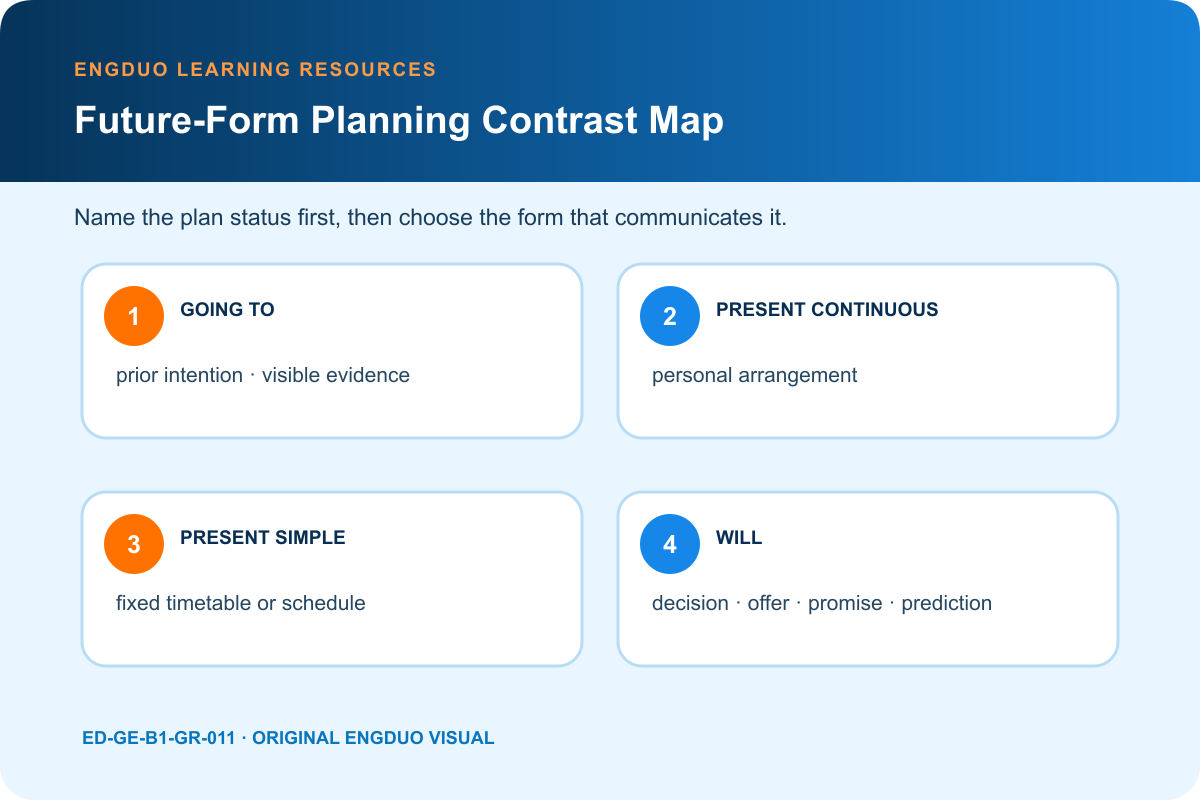
Classify twelve situations as intention, arrangement, schedule, immediate decision, promise, offer, neutral prediction, or evidence-based prediction.
How to run Stage 1
3 min: Classify twelve future meanings.
Show what is decided and what is organised
Build six pairs with going to and present continuous, adding person, time, place, or booking details when the plan is an arrangement.
How to run Stage 2
5 min: Contrast going to intentions with present-continuous arrangements.
Separate external timetables from speaker decisions
Engduo Audio: Listen for meaning first. Audio never starts automatically.
Identify intention, arrangement, timetable, decision now, and promise.
Separate evidence-based prediction, opinion prediction, arrangement, and immediate response.
Complete six planning problems using present simple for fixed schedules and will for decisions, offers, promises, or opinion predictions.
How to run Stage 3
5 min: Contrast present-simple schedules with will decisions, offers, promises, and predictions.
Use context as evidence for form choice
Listen to both clips, label every future form, and explain what each choice tells the listener about status, evidence, or commitment.
How to run Stage 4
6 min: Play both clips and identify status, evidence, and commitment.
Negotiate a practical plan
Plan a one-day work trip with an intention, two arrangements, one fixed timetable, an immediate decision, an offer or promise, and one prediction, then summarise responsibilities.
How to run Stage 5
7 min: Run the practical work-plan negotiation.
Final practice: Make the status of every future action clear
Task: Negotiate and summarise a practical work plan using going to, present continuous, present simple, and will to distinguish intentions, arrangements, schedules, decisions, commitments, and predictions.
Success: Each future form matches the intended status, arrangements contain useful details, schedules are external or fixed, decisions and promises show speaker commitment, and both partners recover the same plan.
LC · Language Control
0 Frequent form problems obscure the intended meaning.
1 Meaning remains clear with some prompting or self-correction.
2 Controls going to, present continuous, present simple, and will according to intention, arrangement, schedule, decision, promise, offer, and prediction meaning.
FP · Functional Performance
0 Does not yet complete the communication outcome.
1 Completes most of the outcome with visible prompts.
2 Negotiates and summarises an independent practical plan whose status, responsibilities, timing, and commitments are clear to both partners.
How to run Stage 6
4 min: Score LC and FP, repair one meaning-form mismatch, and retry it.
คำอธิบายภาษาไทย — เปิดเมื่อจำเป็นเท่านั้น
ก่อนเลือก form ให้เขียนสถานะเหนือประโยค: intention = going to, arrangement = present continuous พร้อมรายละเอียดนัด, schedule = present simple, decision/promise/offer/opinion prediction = will ส่วนหลักฐานที่เห็นชัดมักใช้ going to
Continue your learning path
Teaching references
CEFR Companion Volume — used for communication outcomes and observable progress.
Content and media rights
© 2026 Engduo Thailand. This lesson and its original instructional design, text, visuals, and prepared media are for authorized Engduo use. Do not copy, download, republish, sell, scrape, or use any part in another course, website, dataset, product, or AI system without written permission, except where applicable law permits.