
Identify what will already be happening during that period.
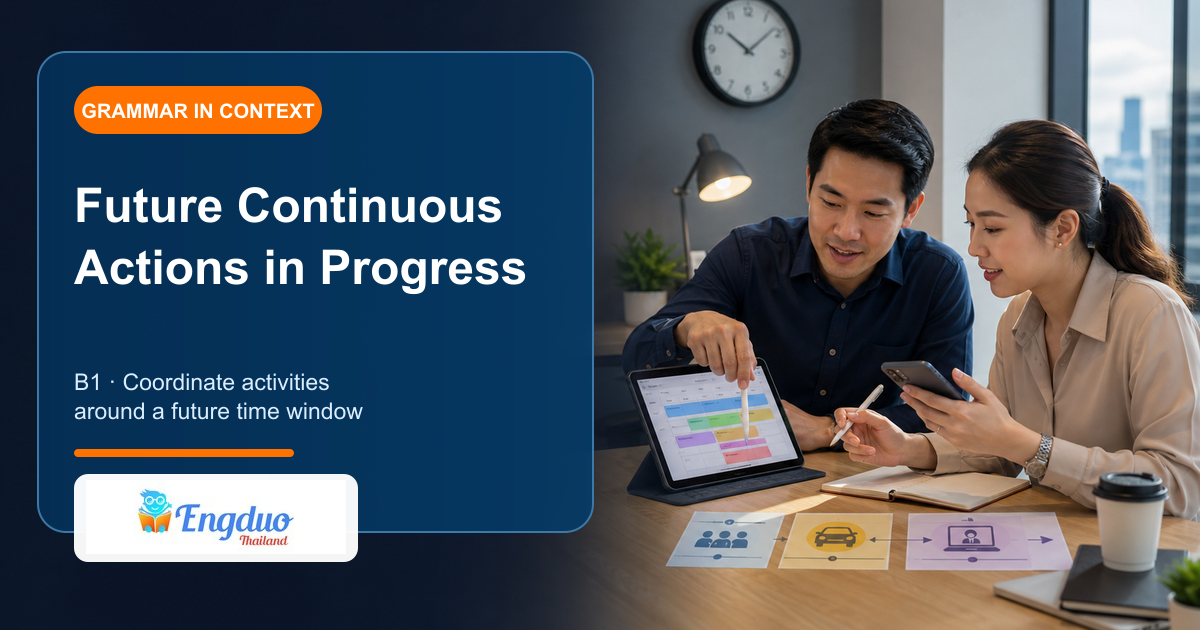
Future Continuous for Actions in Progress
Use the future continuous to describe an activity that will be in progress at a particular future time and coordinate around it.
Future Continuous for actions in progress
UseShow that an activity will be happening around a specified future time rather than simply starting or finishing then.
Core formsubject + will be + verb-ing
Future time anchorat this time tomorrow · when you arrive · from two to four
RememberUse the form for the activity in progress; use a simple future form when the focus is a decision, promise, or completed action.
ชื่อไวยากรณ์ภาษาไทย — เปิดเมื่อจำเป็น
Future Continuous ใช้บอกว่ากิจกรรมหนึ่งจะกำลังดำเนินอยู่ ณ ช่วงเวลาอนาคตที่กำหนด เช่น This time tomorrow, I’ll be travelling โดยเน้นภาพกิจกรรมระหว่างดำเนิน
Your goal
By the end of this lesson, you can describe six activities in progress at future times, ask three coordination questions, and agree on a workable shared schedule.
คำอธิบายเป้าหมายภาษาไทย — เปิดเมื่อจำเป็น
บทนี้ฝึกบอกสิ่งที่จะกำลังทำในช่วงเวลาอนาคตและใช้ข้อมูลนั้นนัดหมาย ประสานงาน หรือหลีกเลี่ยงเวลาที่กิจกรรมซ้อนกัน
Progress focus LCFP
LC · Language Control
Control the target pattern so the intended meaning remains clear.
Control the target pattern so the intended meaning remains clear.
FP · Functional Performance
Complete the lesson’s real communication outcome without teacher-supplied sentences.
Complete the lesson’s real communication outcome without teacher-supplied sentences.
Your grammar path
Add a clear future time anchor and form useful questions.
Compare schedules, identify overlaps, and agree on a practical time.
30-minute lesson route
3 minFuture-window baseline
5 minwill be + -ing
5 minTime anchors and questions
6 minListen and map schedules
7 minCoordination task
4 minFeedback and retry
Place activities inside future time windows
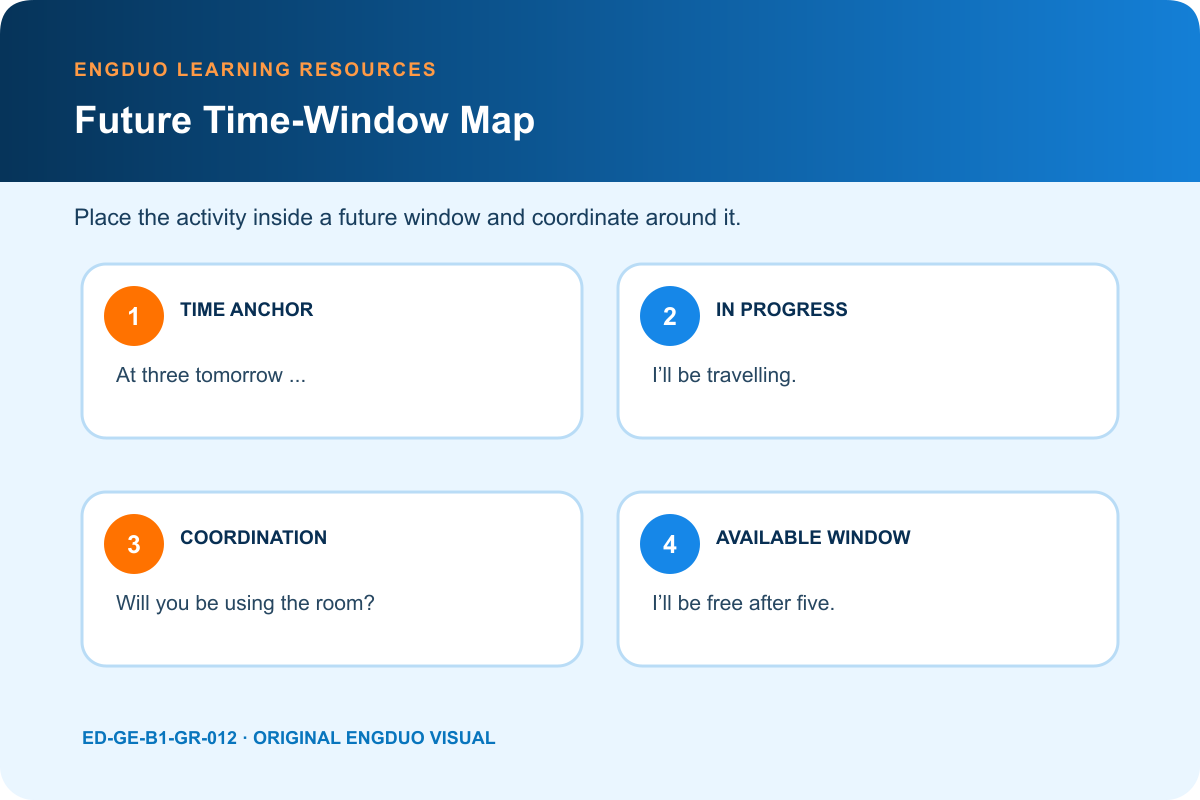
Use six schedule items. Mark whether each activity will be in progress at a time, starts at that time, or is expected to finish by that time.
How to run Stage 1
3 min: Establish six activities and their future time windows.
Build will be plus verb-ing
Practise affirmative, negative, and question forms. Keep be after will and use the -ing form for the activity.
How to run Stage 2
5 min: Build affirmative, negative, and question forms with will be plus -ing.
Add times and polite schedule questions
Engduo Audio: Listen for meaning first. Audio never starts automatically.
Map the activities, time windows, and coordination question.
Identify each future time anchor and the activity in progress around it.
Use at this time tomorrow, when you arrive, and from … to …. Ask Will you be using …? when checking an expected arrangement without sounding demanding.
How to run Stage 3
5 min: Add time anchors and polite coordination questions.
Recover overlapping activities
Listen to both schedules. Place every activity on a timeline and mark the windows when the speakers can meet, call, or share a resource.
How to run Stage 4
6 min: Play both schedules and map overlaps and availability.
Coordinate a shared future schedule
Compare two six-item schedules. Use six future-continuous forms and three questions, identify two conflicts, and agree on one workable meeting or handover time.
How to run Stage 5
7 min: Run the shared-schedule coordination task.
Final practice: Coordinate around future activities in progress
Task: Use six future-continuous forms and three schedule questions to identify two overlaps or conflicts and agree on one workable shared time.
Success: Every activity is linked to a clear future time window and the exchange produces a schedule both speakers can follow.
LC · Language Control
0 Frequent form problems obscure the intended meaning.
1 Meaning remains clear with some prompting or self-correction.
2 Controls will be plus verb-ing and distinguishes an activity in progress from a simple future decision or completion.
FP · Functional Performance
0 Does not yet complete the communication outcome.
1 Completes most of the outcome with visible prompts.
2 Coordinates two schedules and reaches a workable shared time independently.
How to run Stage 6
4 min: Score LC and FP, repair one form or time-window choice, and retry the affected exchange.
คำอธิบายภาษาไทย — เปิดเมื่อจำเป็นเท่านั้น
ให้นึกถึงเส้นเวลาในอนาคตและซูมเข้าไปที่ช่วงหนึ่ง ถ้าต้องการบอกว่าตอนนั้นกิจกรรมกำลังดำเนินอยู่ ใช้ will be + -ing แล้วนำข้อมูลนั้นไปประสานเวลาหรือถามตารางของอีกฝ่าย
Continue your learning path
Teaching references
CEFR Companion Volume — used for communication outcomes and observable progress.
Content and media rights
© 2026 Engduo Thailand. This lesson and its original instructional design, text, visuals, and prepared media are for authorized Engduo use. Do not copy, download, republish, sell, scrape, or use any part in another course, website, dataset, product, or AI system without written permission, except where applicable law permits.