
Identify what the speaker knew, intended, expected, or was close to doing at that past moment.
Future in the Past
Report plans, predictions, scheduled events, imminent actions, and unrealised expectations from an earlier past viewpoint.
Future viewed from the past
UseShow what was planned, expected, predicted, scheduled, imminent, or intended but unrealised at an earlier past moment.
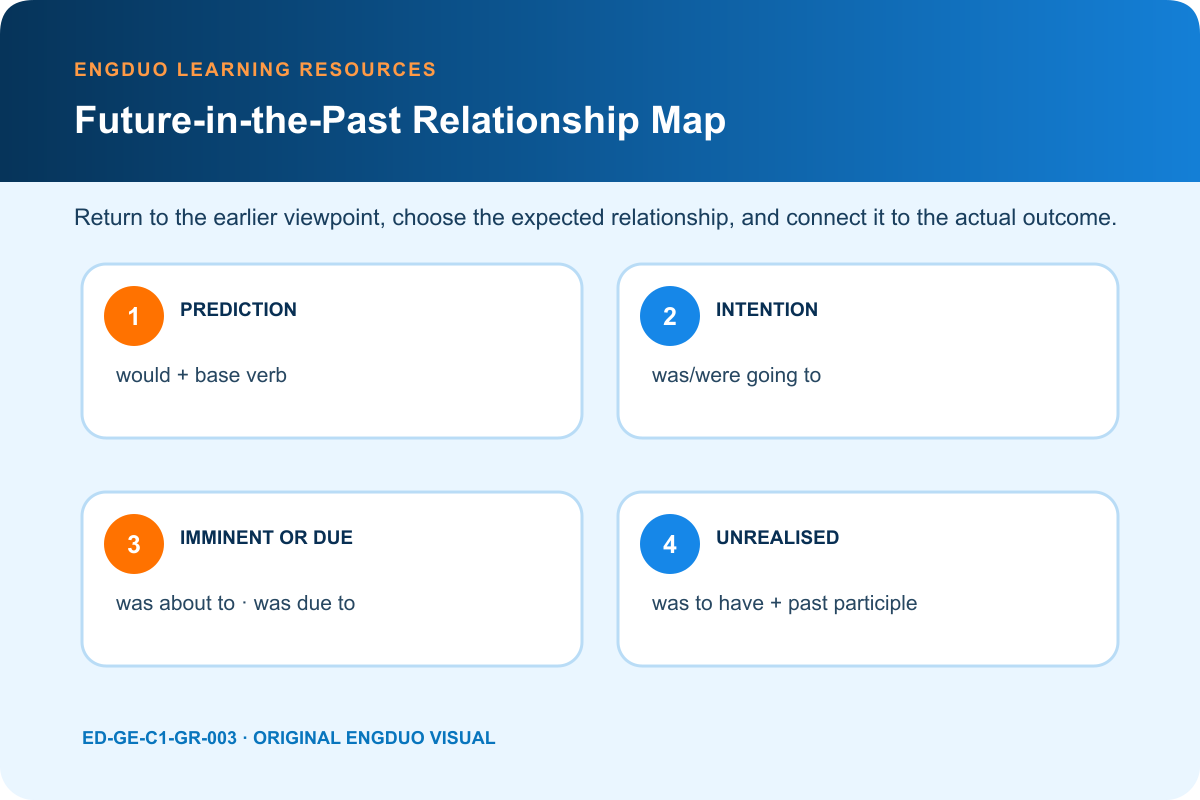
Core formwould · was/were going to · was/were about to · was/were due to
Unrealised expectationwas/were to have + past participle · was/were supposed to have + past participle
RememberThese forms describe a future relationship from a past viewpoint; the later outcome must be stated or made recoverable when it matters.
ชื่อไวยากรณ์ภาษาไทย — เปิดเมื่อจำเป็น
Future in the past ใช้มองแผนหรือความคาดหมายจากจุดหนึ่งในอดีต เช่น would, was going to, was about to, was due to ส่วน was to have done หรือ was supposed to have done มักสื่อว่าสิ่งที่คาดไว้ไม่ได้เกิดตามแผน
Your goal
By the end of this lesson, you can distinguish five future-in-the-past meanings, reconstruct six earlier expectations, and deliver a review that clearly separates the original plan from the actual outcome.
คำอธิบายเป้าหมายภาษาไทย — เปิดเมื่อจำเป็น
บทนี้ฝึกเล่าแผน การคาดการณ์ กำหนดการ เหตุการณ์ที่เกือบเกิด และความคาดหมายที่ไม่สำเร็จจากมุมมองในอดีต พร้อมเปรียบเทียบกับผลที่เกิดจริง
Progress focus LCFP
LC · Language Control
Control the target pattern so the intended meaning remains clear.
Control the target pattern so the intended meaning remains clear.
FP · Functional Performance
Complete the lesson’s real communication outcome without teacher-supplied sentences.
Complete the lesson’s real communication outcome without teacher-supplied sentences.
Your grammar path
Select prediction, intention, imminence, schedule, or unrealised expectation and preserve the correct time reference.
State the original expectation, the change or interruption, and the eventual result without switching viewpoint accidentally.
30-minute lesson route
3 minPast-future baseline
5 minPrediction intention and imminence
5 minSchedule and unrealised expectation
6 minListen and compare outcomes
7 minPlan-review task
4 minFeedback and retry
Separate earlier knowledge from later outcome
Use six plan cards and mark what was known only at the earlier moment and what became known later.
How to run Stage 1
3 min: Separate earlier knowledge from later outcome on six plan cards.
Use would and was/were going to
Distinguish a prediction from an intention and add was/were about to for an imminent interrupted action.
How to run Stage 2
5 min: Build prediction, intention, and imminent-action contrasts.
Use was/were due to and perfect expectation forms
Engduo Audio: Listen for meaning first. Audio never starts automatically.
Classify prediction, intention, schedule, and imminence from the earlier viewpoint.
Identify unrealised expectations and the actual outcomes that replace them.
Show scheduled events and expectations that were not realised, then state the actual outcome.
How to run Stage 3
5 min: Build scheduled and unrealised perfect expectations.
Track expectation, interruption, and result
Listen to both reviews and build paired original-plan versus actual-outcome records.
How to run Stage 4
6 min: Play both reviews and pair each expectation with its outcome.
Review a plan that changed
Give a two-minute retrospective using four future-in-the-past forms, two interruptions, and a clear final outcome.
How to run Stage 5
7 min: Run the changed-plan review with five relationship types.
Final practice: Explain what was expected and what actually happened
Task: Give a two-minute review of a changed plan using prediction, intention, schedule, imminence, and one unrealised perfect expectation.
Success: The earlier viewpoint remains clear, each form matches its relationship, and every important expectation is connected to its actual outcome.
LC · Language Control
0 Frequent form problems obscure the intended meaning.
1 Meaning remains clear with some prompting or self-correction.
2 Controls prediction, intention, imminence, schedule, and unrealised expectation from a past viewpoint.
FP · Functional Performance
0 Does not yet complete the communication outcome.
1 Completes most of the outcome with visible prompts.
2 Reviews a changing plan coherently and independently by contrasting earlier expectations with later outcomes.
How to run Stage 6
4 min: Score LC and FP, repair one viewpoint or fulfilment error, and retry the outcome.
คำอธิบายภาษาไทย — เปิดเมื่อจำเป็นเท่านั้น
เริ่มที่จุดเวลาในอดีตแล้วถามว่าสิ่งนั้นเป็น prediction, intention, imminent action, schedule หรือ expectation ที่ไม่เกิดตามแผน เล่าแผนเดิมก่อนและตามด้วยสิ่งที่ขัดจังหวะกับผลจริงเพื่อไม่ให้มุมมองสับสน
Continue your learning path
Teaching references
CEFR Companion Volume — used for communication outcomes and observable progress.
Content and media rights
© 2026 Engduo Thailand. This lesson and its original instructional design, text, visuals, and prepared media are for authorized Engduo use. Do not copy, download, republish, sell, scrape, or use any part in another course, website, dataset, product, or AI system without written permission, except where applicable law permits.