
The prototype was designed to ___.

Innovation, Evidence, and Impact
Use precise innovation vocabulary to distinguish an idea, prototype, evidence, adoption, scale, impact, and unintended consequence.
Why this lesson matters · เหตุผลที่เรียนบทนี้
For learners: Build precise vocabulary for explaining an innovation through evidence, feasibility, adoption, impact, and unintended consequences.
For teachers: Learners distinguish key innovation concepts, retrieve them from examples, evaluate evidence, and independently explain an innovation before retrying.
สำหรับผู้เรียน: สร้างคำศัพท์ที่แม่นยำสำหรับอธิบายนวัตกรรมผ่านหลักฐาน ความเป็นไปได้ การนำไปใช้ ผลกระทบ และผลที่ไม่ได้ตั้งใจ
สำหรับครู: ผู้เรียนแยกแนวคิดสำคัญของนวัตกรรม เรียกคืนคำจากตัวอย่าง ประเมินหลักฐาน และอธิบายนวัตกรรมแบบอิสระก่อนลองใหม่
Your goal
By the end of this lesson, you can explain an innovation using vocabulary for evidence, feasibility, adoption, unintended effects, and long-term impact..
Why these words matter
Innovation vocabulary separates an attractive idea from a workable prototype and strong evidence. It helps learners explain feasibility, adoption, scale, impact, and unintended consequences without overstating a claim.
30-minute lesson route
- 3 min: goal, situation, and prediction
- 5 min: notice meaning and evidence in the model
- 5 min: select and retrieve the useful language
- 9 min: rehearse and complete the communication task
- 5 min: independent performance, focused feedback, and retry
- 3 min: exit check and next step
Progress focus: VRFP
Engduo Audio: Licensed voices prepared for this lesson. Audio never starts automatically. Use the transcript after the first listening attempt.
1. Look, listen, and notice
Use the visual and model audio to understand the situation, viewpoint, or communication problem before studying the language.
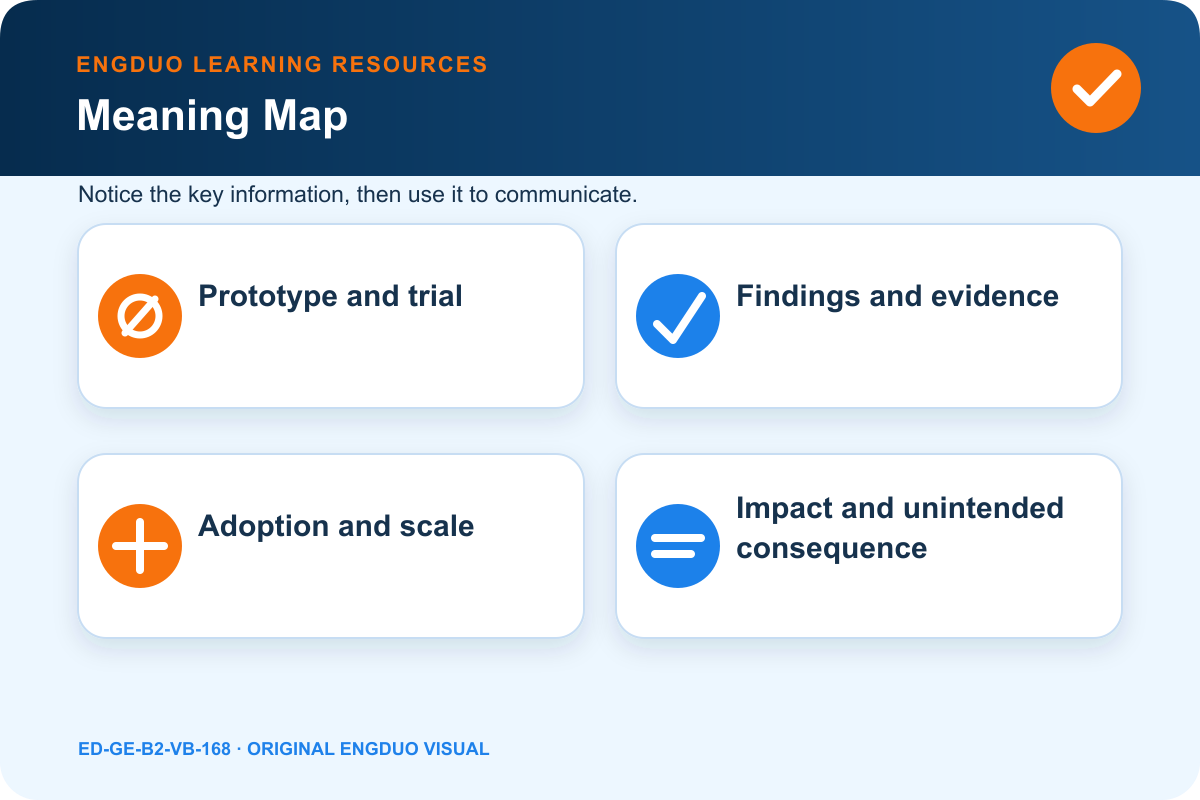
- prototype and trial
- findings and evidence
- adoption and scale
- impact and unintended consequence
Engduo Audio • British English
Transcript — open after listening
The prototype reduced packaging waste in a small trial, but the evidence remains limited because only one neighbourhood participated.
Engduo Audio • American English
Transcript — open after listening
Adoption may depend on simple returns, and the system should not be scaled until loss rates are understood.
How to run Stage 1
Confirm the observable outcome and connect it to one realistic learner need.
2. Build useful language
Choose the phrases that help you complete the task; do not memorise a full script.
Early findings indicate ___.
The evidence remains limited because ___.
Adoption depends on ___.
The idea could be scaled if ___.
An unintended consequence might be ___.
How to run Stage 2
Use the visual and first audio or text for meaning before explaining language.
3. Rehearse with support
Practise the decisions, evidence, listening, or language moves that make the final task successful.
- Build noun–verb–adjective families for innovate, adopt, evaluate, and sustain.
- Match collocations such as conduct a trial, gather evidence, and scale a solution.
- Write six original sentences that move one idea from prototype to impact.
How to run Stage 3
Select only the useful-language items needed for this learner and this task.
4. Complete the communication task
Exchange information, solve a problem, create a text, or reach a decision with a real outcome.
Explain a fictional reusable-delivery-box pilot using ten target terms and decide whether the evidence is strong enough to expand it.
How to run Stage 4
Run the supported rehearsal without reading every instruction aloud.
5. Perform, receive feedback, and retry
Complete the task with keywords only, receive focused feedback, and repeat the weakest part.
Present the innovation pathway from problem to trial, use eight target terms accurately, distinguish finding from claim, and recommend whether to scale, revise, or stop.
Retry: Repeat once with clearer meaning, stronger evidence, more accurate listening, or less support.
How to run Stage 5
Run the main task: Explain a fictional reusable-delivery-box pilot using ten target terms and decide whether the evidence is strong enough to expand it.
Exit check
Complete this without reading a model: Use evidence, adoption, and unintended consequence in one connected recommendation.
Success looks like: The learner uses intermediate innovation vocabulary precisely and connects words in a logical decision pathway.
Evidence: speaking · Repeat the weakest part once after one meaning-focused and one language-focused correction at most.
VR · Vocabulary Resource
2: Uses suitable target vocabulary naturally in an original message.
1: Demonstrates the skill after one focused prompt, correction or self-repair.
0: Cannot yet demonstrate the skill clearly enough to complete the stated outcome.
FP · Functional Performance
2: Completes the real communication outcome independently.
1: Demonstrates the skill after one focused prompt, correction or self-repair.
0: Cannot yet demonstrate the skill clearly enough to complete the stated outcome.
Use these scores after the independent attempt. Record one recurring need in the Engduo app when lesson-result fields become available.
How to run Stage 6
Record focused evidence, give one meaning-focused and one language-focused correction at most, repeat the weakest part, and complete the exit check.
คำอธิบายภาษาไทย — เปิดเมื่อจำเป็นเท่านั้น
แยก idea, prototype, trial, finding, evidence, adoption, scale และ impact ให้ชัด แล้วแต่งประโยคเชื่อมเป็นเส้นทางการพัฒนา
Teacher guide
30-minute must-do route
- Confirm the observable outcome and connect it to one realistic learner need.
- Use the visual and first audio or text for meaning before explaining language.
- Select only the useful-language items needed for this learner and this task.
- Run the supported rehearsal without reading every instruction aloud.
- Run the main task: Explain a fictional reusable-delivery-box pilot using ten target terms and decide whether the evidence is strong enough to expand it.
- Record focused evidence, give one meaning-focused and one language-focused correction at most, repeat the weakest part, and complete the exit check.
60-minute extension
- Compare two pilots with different evidence quality and justify which deserves funding.
- Change the role, information, listener, or constraint so the learner transfers the skill rather than repeating the same answer.
- Compare the first and second performance and record one specific improvement.
Make it easier
Arrange target words on a six-step innovation pathway before speaking.
Make it harder
Compare two pilots with different evidence quality and justify which deserves funding.
Likely difficulty
The learner may call every positive result proof or confuse invention with adoption.
Correction priority
Prioritise word-family control, collocation, evidence strength, and decision logic.
Thai support rule
Keep the Thai panel closed unless examples, visuals, replay, reformulation, and simpler English do not allow progress. Explain only the key distinction, then return to English.
Progress record
Score VR, FP from 0–2 and record one recurring need from: innovation-collocations, evidence-language, original-sentences.
Retry
Give one meaning-focused correction and one language-focused correction at most, then ask for a second attempt with fewer visible prompts.
Continue your learning path
Continue your learning path
Evaluate an Innovation: Evidence, Benefit, and Risk
Evaluate an innovation with evidence
ประเมินนวัตกรรมด้วยหลักฐาน
- Council of Europe — CEFR Companion Volume — Supports action-oriented language learning through age- and level-appropriate interaction, descriptions, goal-oriented co-operation, written interaction, and observable communication outcomes.
- British Council LearnEnglish — B1–B2 vocabulary — Supports topic-based intermediate vocabulary learning that develops meaning, pronunciation, spelling, recall, and confident communication.
Content and media rights
© 2026 Engduo Thailand. Authorized Engduo use only. Copying, republishing, reselling, scraping, or reuse in another course, dataset, product, or AI system requires written permission except where applicable law permits.