
Decide whether the ability existed over a period or one action succeeded in one situation.
could, was able to, and managed to for Past Ability
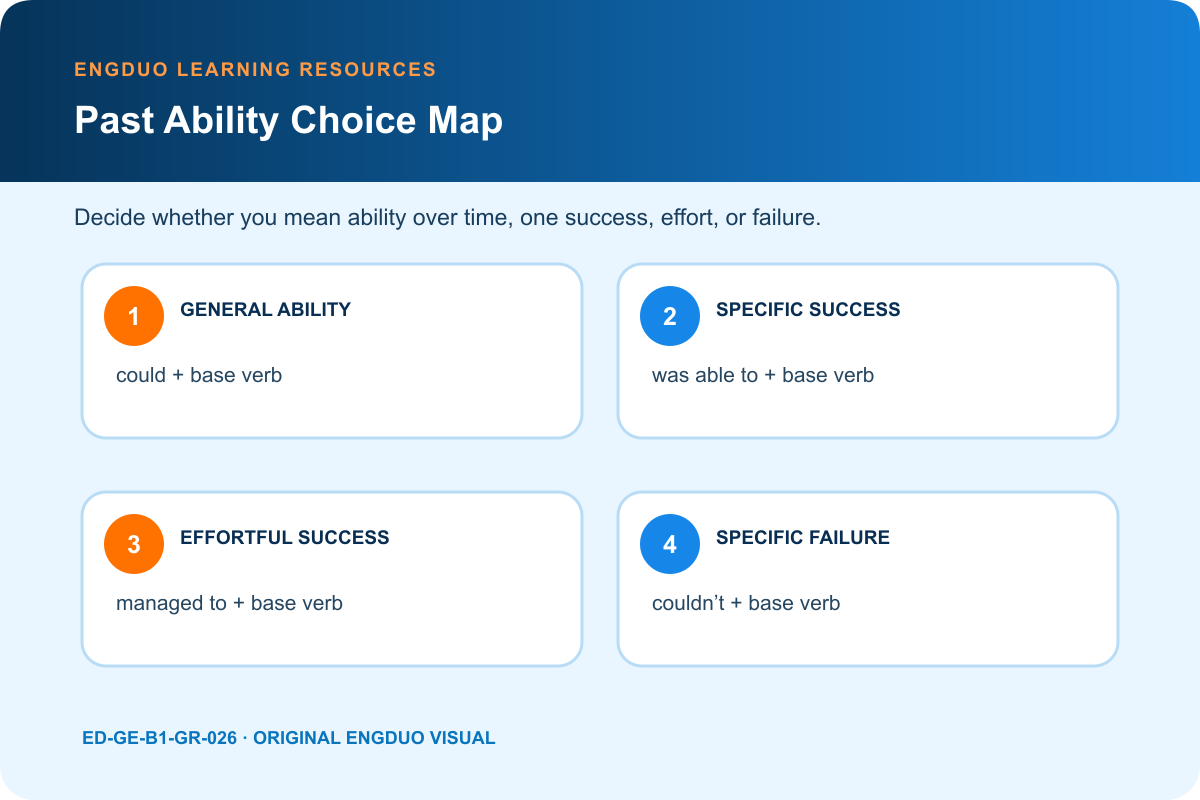
Use could for general past ability and was able to or managed to for a successful achievement in one specific difficult situation.
Past ability with could, was able to, and managed to
UseSeparate a general ability in a past period from successful action in one specific situation, especially when effort or difficulty matters.
Core formgeneral ability: could + base verb
Specific successwas/were able to + base verb · managed to + base verb
RememberIn affirmative specific-success stories, was able to or managed to is usually clearer than could; couldn’t works naturally for a specific failure.
ชื่อไวยากรณ์ภาษาไทย — เปิดเมื่อจำเป็น
could ใช้บอกความสามารถทั่วไปในอดีต ส่วน was able to และ managed to ใช้เมื่อทำสำเร็จในเหตุการณ์เฉพาะ โดย managed to เน้นว่ามีความยากหรือใช้ความพยายาม
Your goal
By the end of this lesson, you can describe four general past abilities, report three specific successes or failures, and explain the difficulty and strategy behind one achievement.
คำอธิบายเป้าหมายภาษาไทย — เปิดเมื่อจำเป็น
บทนี้ฝึกเล่าความสามารถทั่วไปกับความสำเร็จเฉพาะเหตุการณ์ให้ต่างกัน แล้วขยายเรื่องด้วยอุปสรรค วิธีแก้ และผลที่ทำสำเร็จ
Progress focus LCFP
LC · Language Control
Control the target pattern so the intended meaning remains clear.
Control the target pattern so the intended meaning remains clear.
FP · Functional Performance
Complete the lesson’s real communication outcome without teacher-supplied sentences.
Complete the lesson’s real communication outcome without teacher-supplied sentences.
Your grammar path
Use the form that shows general ability, specific success, effortful achievement, or failure.
Explain what was difficult, what you tried, and how the result was achieved.
30-minute lesson route
3 minAbility-or-event baseline
5 minGeneral ability with could
5 minSpecific success and failure
6 minListen and classify
7 minAchievement account
4 minFeedback and retry
Separate ability over time from one event
Use seven examples. Mark past-period ability, specific success, effortful success, or specific failure before selecting the form.
How to run Stage 1
3 min: Classify seven examples as general ability or specific outcome.
Use could for general past ability
Build affirmative, negative, and question forms with could and the base verb. Establish a clear past period or stage of life.
How to run Stage 2
5 min: Build could statements, negatives, and questions.
Use was able to or managed to for success
Engduo Audio: Listen for meaning first. Audio never starts automatically.
Separate the general abilities, specific success, and effortful achievement.
Identify the past ability, one successful action, and the difficult final achievement.
Use was or were able to for a completed success and managed to when difficulty or persistence matters. Use couldn’t for a specific failure.
How to run Stage 3
5 min: Contrast was able to, managed to, and couldn’t in events.
Recover ability, challenge, and outcome
Listen to both accounts. Record the general skill, specific problem, selected form, strategy, and result.
How to run Stage 4
6 min: Play both accounts and map skill, challenge, strategy, and outcome.
Tell a challenge-and-success account
Describe four general past abilities and three specific events. Include one failure, two successes, the main difficulty, and the strategy that produced one achievement.
How to run Stage 5
7 min: Run the challenge-and-success account.
Final practice: Show the difference between having a skill and succeeding once
Task: Give a connected account with four general abilities, three specific outcomes, accurate could/was able to/managed to choices, and one explained challenge strategy.
Success: The forms clearly distinguish ability over a period from a successful or unsuccessful action in one event.
LC · Language Control
0 Frequent form problems obscure the intended meaning.
1 Meaning remains clear with some prompting or self-correction.
2 Controls the three past-ability forms and separates general ability from specific success or failure.
FP · Functional Performance
0 Does not yet complete the communication outcome.
1 Completes most of the outcome with visible prompts.
2 Delivers a clear challenge-and-achievement account with a meaningful strategy independently.
How to run Stage 6
4 min: Score LC and FP, repair one ability-or-achievement choice, and retry the affected event.
คำอธิบายภาษาไทย — เปิดเมื่อจำเป็นเท่านั้น
ถ้าเล่าทักษะที่มีอยู่ในช่วงหนึ่งใช้ could หากเล่าว่าทำสิ่งหนึ่งสำเร็จในเหตุการณ์เฉพาะใช้ was able to และถ้าต้องฝ่าความยากจนสำเร็จใช้ managed to ส่วน couldn’t ใช้กับความล้มเหลวเฉพาะเหตุการณ์ได้
Continue your learning path
Teaching references
CEFR Companion Volume — used for communication outcomes and observable progress.
Content and media rights
© 2026 Engduo Thailand. This lesson and its original instructional design, text, visuals, and prepared media are for authorized Engduo use. Do not copy, download, republish, sell, scrape, or use any part in another course, website, dataset, product, or AI system without written permission, except where applicable law permits.