
Identify the later past event before deciding what had already happened.

Past Perfect for an Earlier Past Event
Use the past perfect to make the earlier event clear when two important events belong to the past.
Past Perfect for an earlier past event
UseShow that one event was already complete before another past event or reference point.
Core formsubject + had + past participle
Timeline contrastearlier event: had + participle · later event: past simple
RememberUse the past perfect where it helps the listener recover the order; do not force it into every sentence of a story.
ชื่อไวยากรณ์ภาษาไทย — เปิดเมื่อจำเป็น
Past Perfect ใช้ทำให้ชัดว่าเหตุการณ์หนึ่งเกิดและเสร็จก่อนอีกเหตุการณ์ในอดีต โครงสร้าง had + past participle ส่วนเหตุการณ์ที่ตามมามักใช้ Past Simple
Your goal
By the end of this lesson, you can reconstruct four two-event timelines, use the past perfect for the earlier event, and explain a cause or surprise clearly.
คำอธิบายเป้าหมายภาษาไทย — เปิดเมื่อจำเป็น
บทนี้ฝึกเรียงเหตุการณ์อดีตสองชั้น โดยเลือก Past Perfect เฉพาะจุดที่ช่วยให้ผู้ฟังรู้ว่าอะไรเกิดก่อน แล้วใช้ลำดับนั้นอธิบายสาเหตุหรือเหตุการณ์ที่น่าประหลาดใจ
Progress focus LCFP
LC · Language Control
Control the target pattern so the intended meaning remains clear.
Control the target pattern so the intended meaning remains clear.
FP · Functional Performance
Complete the lesson’s real communication outcome without teacher-supplied sentences.
Complete the lesson’s real communication outcome without teacher-supplied sentences.
Your grammar path
Use had plus the past participle for the event before the reference point.
Connect the earlier event to the later problem, discovery, or reaction.
30-minute lesson route
3 minTwo-event baseline
5 minEarlier and later past
5 minCause and surprise
6 minListen and reorder
7 minTimeline account
4 minFeedback and retry
Place the later past reference point
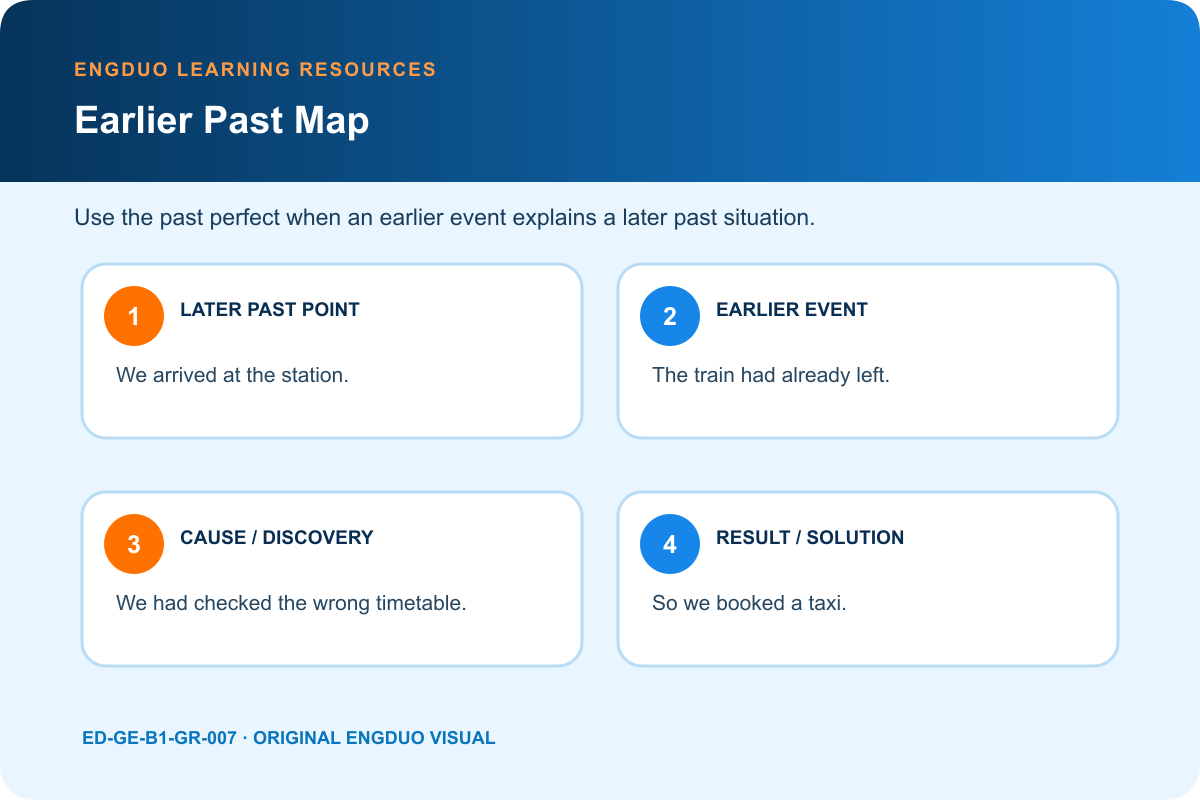
Use four short situations. Mark the arrival, discovery, start, or reaction that acts as the later past point, then identify what was already complete.
How to run Stage 1
3 min: Establish four two-event situations and later reference points.
Use had plus the past participle for the earlier event
Build affirmative and negative forms and practise common participles such as left, read, forgotten, connected, gone, and finished.
How to run Stage 2
5 min: Build earlier events with had plus past participles.
Explain cause, discovery, or surprise
Engduo Audio: Listen for meaning first. Audio never starts automatically.
Order the arrival, train departure, schedule mistake, realisation, and solution.
Identify the earlier causes and the later results.
Use when, by the time, because, and already where they support the relationship. Keep ordinary story sequence in the past simple when the order is already clear.
How to run Stage 3
5 min: Connect earlier causes to later discoveries, problems, or surprises.
Recover the hidden earlier events
Listen to both accounts. Put every event on a two-level timeline and explain which earlier event caused or changed the later situation.
How to run Stage 4
6 min: Play both accounts and reconstruct two-level timelines.
Tell a cause-before-result account
Tell a real or plausible problem story with at least four past events. Use two past-perfect forms for earlier causes and past simple for later events, then answer one order question.
How to run Stage 5
7 min: Run the four-event cause-before-result account.
Final practice: Make the earlier cause clear in a past account
Task: Tell a connected four-event account using two accurate past-perfect forms, later past-simple events, one clear cause or surprise, and one timeline answer.
Success: The listener can reconstruct the event order and understand how the earlier event created the later situation.
LC · Language Control
0 Frequent form problems obscure the intended meaning.
1 Meaning remains clear with some prompting or self-correction.
2 Controls had + past participle and distinguishes earlier past from the later past reference point.
FP · Functional Performance
0 Does not yet complete the communication outcome.
1 Completes most of the outcome with visible prompts.
2 Delivers a clear cause-before-result account and answers the timeline question independently.
How to run Stage 6
4 min: Score LC and FP, repair one timeline or participle issue, and retry the affected section.
คำอธิบายภาษาไทย — เปิดเมื่อจำเป็นเท่านั้น
เริ่มจากเหตุการณ์อดีตที่เป็นจุดอ้างอิง เช่นไปถึงหรือเริ่มประชุม แล้วถามว่าอะไรเกิดเสร็จก่อนจุดนั้น เหตุการณ์ก่อนใช้ had + past participle ส่วนลำดับเรื่องทั่วไปที่ชัดอยู่แล้วไม่จำเป็นต้องใช้ Past Perfect ทุกประโยค
Continue your learning path
Teaching references
CEFR Companion Volume — used for communication outcomes and observable progress.
Content and media rights
© 2026 Engduo Thailand. This lesson and its original instructional design, text, visuals, and prepared media are for authorized Engduo use. Do not copy, download, republish, sell, scrape, or use any part in another course, website, dataset, product, or AI system without written permission, except where applicable law permits.