
Decide whether the result or process stage matters more than the actor.
Perfect Passive Forms: Results across Time
Use perfect passive forms when the completed result, affected object, or stage of a process matters more than the actor.
Perfect passive forms
UseReport a result completed by the present, by a past reference point, or by a future checkpoint while keeping the affected item in focus.
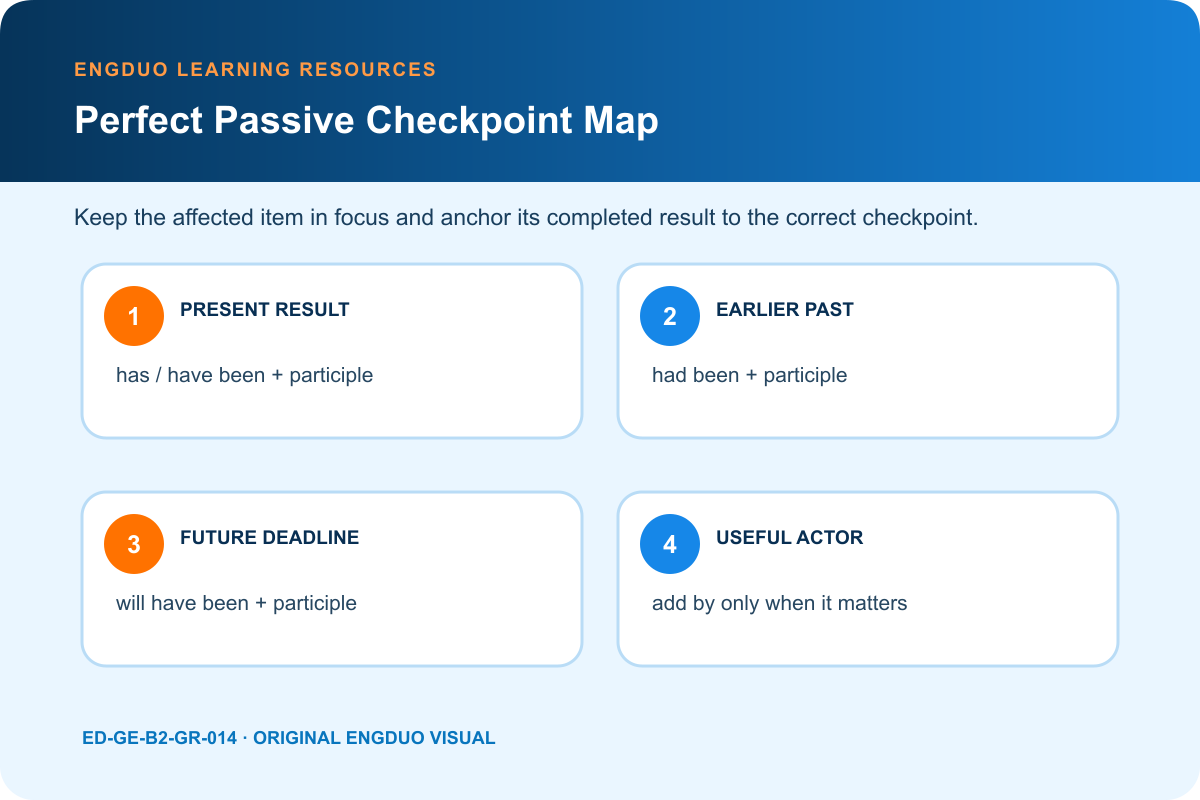
Core formhas/have been + participle · had been + participle · will have been + participle
Focus choiceaffected item or completed stage first · actor with by only when useful
RememberBeen carries the perfect meaning and the following past participle carries the passive meaning; both are required.
ชื่อไวยากรณ์ภาษาไทย — เปิดเมื่อจำเป็น
Perfect Passive ใช้เน้นว่าสิ่งใดถูกทำเสร็จแล้ว ณ ตอนนี้ ก่อนจุดในอดีต หรือก่อนจุดในอนาคต เช่น has been approved, had been tested, will have been delivered
Your goal
By the end of this lesson, you can report six process results across present, past, and future checkpoints, choose passive focus, and identify one delayed stage and response.
คำอธิบายเป้าหมายภาษาไทย — เปิดเมื่อจำเป็น
บทนี้ฝึกอัปเดตสถานะงานหลายช่วงเวลาโดยเน้นสิ่งที่เสร็จหรือได้รับผล มากกว่าคนทำ พร้อมแยก Present, Past และ Future Perfect Passive และตอบสนองต่อจุดที่ล่าช้า
Progress focus LCFP
LC · Language Control
Control the target pattern so the intended meaning remains clear.
Control the target pattern so the intended meaning remains clear.
FP · Functional Performance
Complete the lesson’s real communication outcome without teacher-supplied sentences.
Complete the lesson’s real communication outcome without teacher-supplied sentences.
Your grammar path
Use has or have been, had been, or will have been plus the participle.
Connect six results across time and act on one incomplete or delayed stage.
30-minute lesson route
3 minResult-focus baseline
5 minPresent and past perfect passive
5 minFuture perfect passive
6 minListen and build status line
7 minProcess-status briefing
4 minFeedback and retry
Choose result focus instead of actor focus
Use six process stages. Decide when the affected item or completed result is the useful sentence subject.
How to run Stage 1
3 min: Choose result focus for six process stages.
Use has/have been and had been
Connect present status to now and earlier completion to a later past checkpoint. Keep both been and the passive participle.
How to run Stage 2
5 min: Build present and past perfect-passive checkpoints.
Use will have been plus participle
Engduo Audio: Listen for meaning first. Audio never starts automatically.
Place each affected item and result at its present, past, or future checkpoint.
Track completed stages, useful actor information, and the remaining issue.
State what will be complete by a deadline and contrast one stage that may remain incomplete.
How to run Stage 3
5 min: Build future perfect-passive deadlines and one incomplete contrast.
Recover item, checkpoint, result, and remaining issue
Listen to both reports. Place every stage on a present, past, or future checkpoint line and note any useful by-agent.
How to run Stage 4
6 min: Play both reports and construct the three-time status lines.
Deliver a multi-time process report
Report six stages using two present, two past, and two future perfect-passive forms. Explain one delay and agree on one response.
How to run Stage 5
7 min: Run the six-stage process briefing and delay response.
Final practice: Report what has, had, and will have been completed
Task: Give a two-minute status report with six perfect-passive results across three checkpoints, one useful by-agent, one delayed stage, and one response.
Success: Forms accurately anchor completion to each checkpoint and passive focus helps the listener understand status and next action.
LC · Language Control
0 Frequent form problems obscure the intended meaning.
1 Meaning remains clear with some prompting or self-correction.
2 Controls has/have/had/will have been plus the passive participle across three time references.
FP · Functional Performance
0 Does not yet complete the communication outcome.
1 Completes most of the outcome with visible prompts.
2 Delivers a coherent result-focused status report and responds to one delay independently.
How to run Stage 6
4 min: Score LC and FP, repair one auxiliary chain or checkpoint issue, and retry the affected status.
คำอธิบายภาษาไทย — เปิดเมื่อจำเป็นเท่านั้น
เลือกสิ่งที่ถูกทำเป็นประธานแล้วกำหนดจุดเวลา ตอนนี้ใช้ has/have been + participle ก่อนจุดอดีตใช้ had been + participle และก่อนจุดอนาคตใช้ will have been + participle ใส่ by + ผู้ทำเฉพาะเมื่อข้อมูลนั้นมีประโยชน์
Continue your learning path
Teaching references
CEFR Companion Volume — used for communication outcomes and observable progress.
Content and media rights
© 2026 Engduo Thailand. This lesson and its original instructional design, text, visuals, and prepared media are for authorized Engduo use. Do not copy, download, republish, sell, scrape, or use any part in another course, website, dataset, product, or AI system without written permission, except where applicable law permits.