IDEA · Critical thinking & imagination
0 The talk remains a list of visible objects or copied prompts.
1 One interpretation or judgement develops with support.
2 Original ideas, reasons, possibilities, or consequences develop clearly.

Topic FamilyTF06 · Daily Routines, Habits & Time
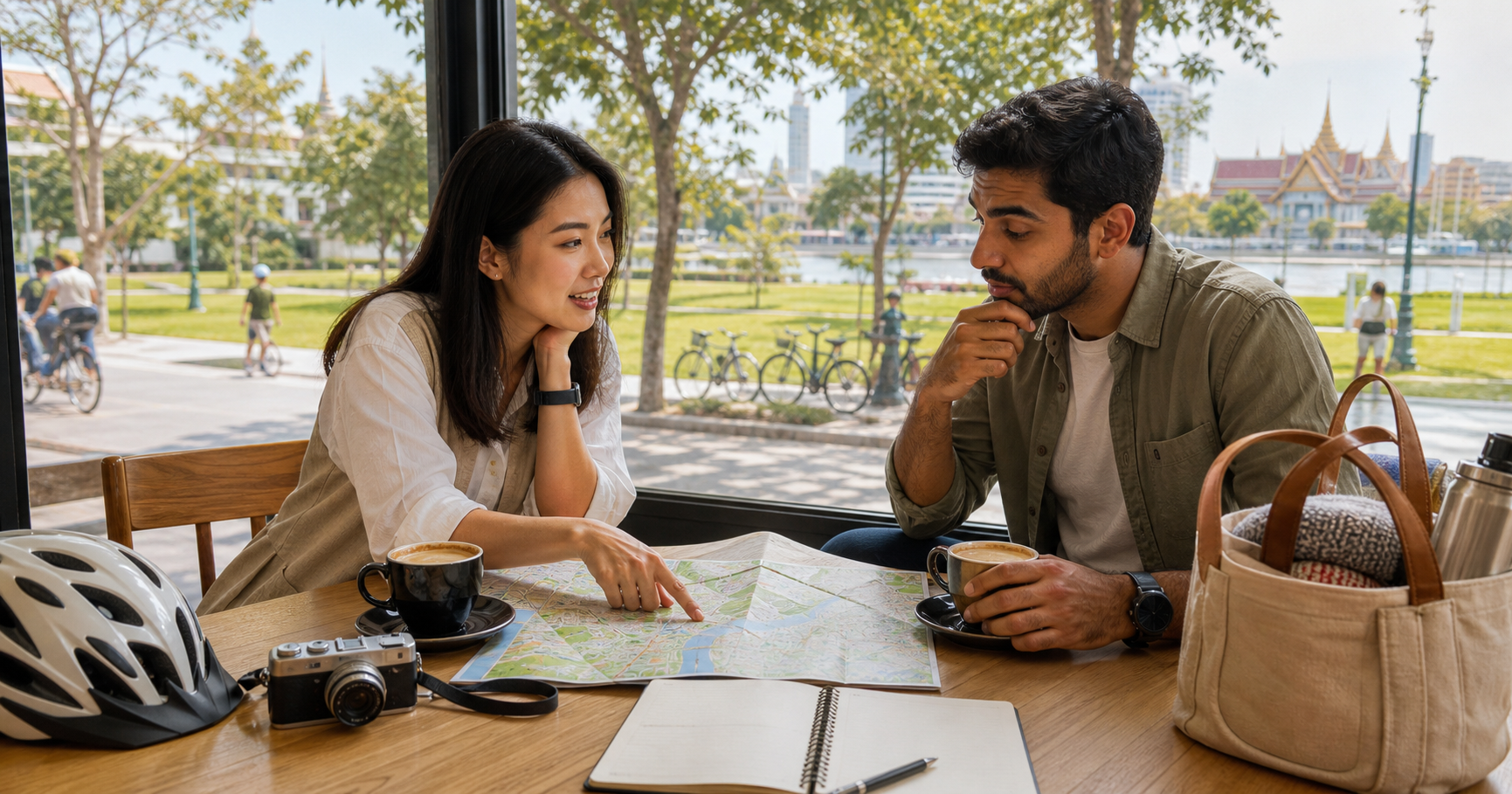
Use one picture to notice competing possibilities, imagine the story, compare weekend priorities, and create a conversation that can move in any meaningful direction.
For learners: Everyday decisions give learners a familiar topic for comparing priorities, negotiating choices and continuing a natural conversation.
For teachers: The visual leads. Learners observe, choose optional language, compare weekend options, ask connected questions, find a compromise, and sustain an unscripted discussion. No listening audio or model answer.
สำหรับผู้เรียน: การตัดสินใจในชีวิตประจำวันเป็นหัวข้อที่คุ้นเคยสำหรับฝึกเปรียบเทียบสิ่งสำคัญ เจรจาทางเลือก และสนทนาต่ออย่างเป็นธรรมชาติ
สำหรับครู: ภาพเป็นแกนหลัก ผู้เรียนสังเกต เลือกภาษาที่ต้องการ เปรียบเทียบทางเลือก ถามต่อ หาจุดร่วม และสนทนาโดยไม่มีบทตายตัว ไม่มีเสียงฟังหรือคำตอบตัวอย่าง
By the end of this lesson, you can interpret the picture, use selected weekend words and phrasal verbs, compare choices and trade-offs, and sustain a two-minute discussion without following a script.
ใช้ภาพเป็นจุดเริ่มต้นในการสังเกตและจินตนาการ เปรียบเทียบตัวเลือกสำหรับวันหยุด เลือกใช้คำศัพท์หรือ phrasal verbs ที่ช่วยสื่อความคิด แล้วพูดคุยอย่างอิสระโดยไม่ต้องตอบตามลำดับหรือท่องบทพูด
The picture leads; the learner chooses the direction. Vocabulary, phrasal verbs, sentence starters, and questions are optional resources—not boxes to complete. Do not add listening audio or a model answer.
| Stage | Teacher move | Evidence |
|---|---|---|
| 1 | Ask what the learner notices before giving any vocabulary. | Details + first inference |
| 2 | Let the learner select only the words that support their emerging weekend idea. | Useful language choices |
| 3 | Accept different stories when the learner can connect them to visual evidence. | Original possibility |
| 4 | Challenge one assumption and ask about a practical trade-off or consequence. | Reasoned judgement |
| 5 | Follow the learner’s idea instead of completing every prompt. | Learner-led exchange |
| 6 | Score IDEA/LANG/TALK 0–2, give one target, then retry only that part. | Independent talk + improvement |
Choose your own direction: adventure, rest, friendship, money, planning, spontaneity, local travel, or another idea you notice.
4 min. Ask for three visible details before interpretation. Label clearly: “I can see…” versus “I imagine…” The learner may introduce a different topic if it grows naturally from the image.
You do not need to use every item. Select the language that makes your own interpretation more precise.
Language note: A phrasal verb combines a verb with a particle, creating a meaning that may differ from the verb alone.
5 min. Ask the learner to choose three topic words and one or two phrasal verbs. They may reject or replace any item. Meaningful choice matters more than using the full list.
Optional sentence starters: They may have… · Perhaps one person wants… · The real difficulty could be… · If the weather changes…
5 min. Ask the learner to build one coherent possibility, not the “correct” story. Follow up with “Which detail in the picture gave you that idea?”
Useful thinking language: It depends on… · The advantage is…, but the drawback is… · We may be assuming that… · A fair compromise would be…
5 min. Choose one question only if it creates depth. Ask for a reason, an example, and one possible consequence. Do not force the learner through all three cards.
Start anywhere: the people, the map, the bike, the camera, the picnic bag, your ideal weekend, or a choice you have made in real life. Speak, respond, and let the conversation change direction naturally.
Freedom rule: You may leave the picture and connect the idea to real life once the conversation has a clear direction.
5 min. Facilitate rather than lead. Ask questions generated by the learner’s last idea. Avoid returning to unused prompts simply because they are on the page.
Task: Choose one weekend idea inspired by the picture. Develop it with imagination or critical thinking, use any useful new language, respond to two genuine follow-up questions, and add a final thought that was not prepared in advance.
Success: The discussion sounds like your thinking—not a completed worksheet or memorised model.
0 The talk remains a list of visible objects or copied prompts.
1 One interpretation or judgement develops with support.
2 Original ideas, reasons, possibilities, or consequences develop clearly.
0 General words repeatedly block the intended meaning.
1 Selected new language helps after prompts or correction.
2 Topic words and expressions are chosen naturally to make ideas precise.
0 The teacher manages most of the discussion.
1 The learner continues with visible prompts or one reminder.
2 The learner develops, responds, questions, and extends independently.
Result: 0–2 Rebuild · 3–4 Developing · 5–6 Independent.
Feedback + retry: Keep the first score. Choose one target—deeper idea, more precise language, or more independent interaction—and retry only the weakest part.
6 min. Record IDEA/LANG/TALK from 0–2 before feedback. Give one precise target and run a short focused retry without restarting the entire discussion.
Free Talk ใช้ภาพเป็นแรงกระตุ้น ไม่ได้กำหนดคำตอบเดียวหรือบังคับให้ตอบครบทุกคำถาม เลือกคำศัพท์ที่ช่วยความคิดของคุณ จินตนาการสิ่งที่ภาพไม่ได้บอก เปรียบเทียบตัวเลือกสำหรับวันหยุด แล้วปล่อยให้บทสนทนาดำเนินไปตามความหมายที่เกิดขึ้นจริง
Start with a short guided talk about daily routines.
เริ่มจากบทพูดแบบมีโครงเรื่องกิจวัตรประจำวัน
Listen for plans, times, and changing arrangements.
ฝึกฟังแผน เวลา และการเปลี่ยนแปลง
Use another visual to compare habits, choices, and better days.
ใช้ภาพอีกฉากเพื่อเปรียบเทียบนิสัย ทางเลือก และวันที่ดีขึ้น
Analyse time pressure and agree one better routine.
ทบทวนด้วยการวิเคราะห์แรงกดดันและเลือกกิจวัตรที่ดีขึ้น
CEFR Companion Volume — used for interaction, turn-taking, and observable communication outcomes.
© 2026 Engduo Thailand. This lesson and its original instructional design, text, visuals, and prepared media are for authorized Engduo use. Do not copy, republish, sell, scrape, or use any part in another course, website, dataset, product, or AI system without written permission, except where applicable law permits.